
Conservative bloc takes a slim lead in New Zealand election that’s still too close to call
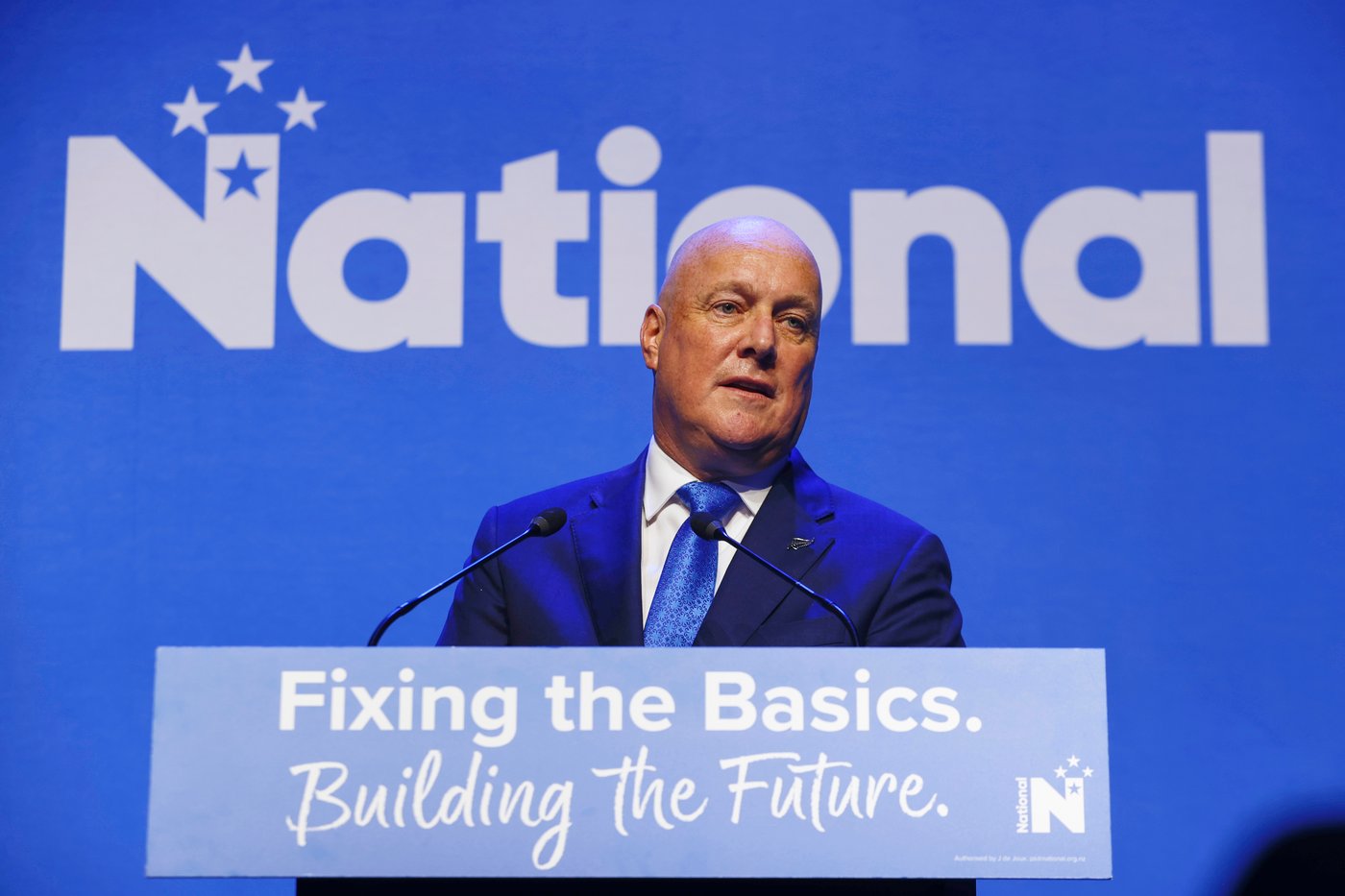
WELLINGTON, New Zealand (AP) — With more than 95% of the votes counted, New Zealand’s election produced no definitive victory for the right or the left on Saturday but the incumbent conservative government hovered on the brink of a wafer-thin majority that could allow it to eke out a precarious return to power.
Christopher Luxon’s National party and its minor party coalition partners, libertarian ACT and populist NZ First, were getting close to the slimmest possible return — by just one seat. It suggested that securing a second term could take lengthy negotiations and would rely on votes counted after election day, which have historically skewed left.
The leftwing bloc, led by the Labour party and Chris Hipkins, appeared to have fallen short of a majority. However, as New Zealand’s Electoral Commission unveiled the counts, it became clear the night would end without certainty about who would form the next government, a process likely to take weeks.
Luxon did not claim victory in a speech to supporters at National’s headquarters in Auckland after midnight.
“National is once again the largest party in Parliament and we have a pathway to forming the next government,” Luxon said. “But I have to tell you right now it is too close to call.”
Earlier, at the Labour headquarters in Upper Hutt, outside of Wellington, a smiling Hipkins did not concede defeat.
“Tonight, New Zealand has spoken,” Hipkins told supporters. “It may take us a little bit longer to figure out exactly what it is that you’ve said.”
Still, the unclear outcome was punishing for both National and Labour, the major political parties that have long dominated New Zealand politics. Both got under 30% of the vote, underscoring opinion polls before election day that showed little public enthusiasm for either party.
A newcomer to politics who surged in popularity is poised to enter Parliament
Voters instead bolstered power for minor parties on the ideological flanks and propelled to office a centrist political newcomer, Qiulae Wong of the Opportunity party, who has pledged a non-partisan and pragmatic agenda that draws from socially liberal, technocratic and pro-environment ideals.
It was too soon to know whether the support of 38-year-old Wong, whose party appeared set to enter Parliament for the first time, would be required for any leader seeking to form a governing majority.
New Zealanders don’t elect prime ministers. Instead they cast two votes, one for their preferred party and one to select a local representative.
Parties must either win a constituency seat, or win 5% of the preferred party vote, to enter Parliament. New entrant parties are rare and Opportunity, on current results, would be the first in more than a decade.
The magnitude of Wong’s success was still undecided, with the count Saturday showing Opportunity had just crossed the 5% threshold, allowing the party seven seats.
Wong has said that if she held the tiebreaker power, she was open to negotiating with either a conservative or a leftwing government and would deal first with whichever major party won the most votes.
The rightwing bloc might not need her, and Luxon has ruled out governing with Opportunity. Analysts say, however, that both major party leaders would likely answer the phone if Wong held the only path to power.
Early results show conservatives with a wafer-thin majority
To govern, a coalition of parties must hold more than half of parliament’s seats. The total number of seats is determined by official calculations on election night based on quirks of the country’s vote.
Saturday figures showed there could be a 130-seat Parliament, with 66 seats needed for a majority. However, parties negotiating shared governing arrangements would prefer a more comfortable margin. Results suggested a coalition of National, ACT and NZ First would hold 67 seats, a number that fluctuated as the night continued.
The 67 included 42 for National, 13 for ACT and 12 for NZ First — a drop for National and a gain for the two minor parties. The result will likely cause headaches for Luxon, whose detractors criticized his political inexperience during his tenure in a power-sharing deal with two veteran and canny politicians, David Seymour of ACT and Winston Peters of NZ First.
Both will want greater influence in any coalition on Saturday’s results, and Luxon’s woes won’t end there.
Lawmakers from the conservative parties who spoke to news outlets Saturday night avoided declaring victory. So-called special votes cast by New Zealanders who live abroad or are travelling on election day are counted later, and historically favor the left.
In the past four elections, National lost one or two seats when the special votes were counted, while leftwing parties won between one and three additional seats.
Saturday’s emerging results also suggested a shocking exit from parliament for a few of National’s most senior figures, including the incumbent government’s Finance Minister Nicola Willis, Speaker of the House Gerry Brownlee, Defense and Justice Minister Paul Goldsmith, and Attorney-General and Transport Minister Chris Bishop.
The leftwing bloc has fallen short so far
Meanwhile, the left bloc, led by Hipkins and Labour, held a combined 56 seats, though numbers there also fluctuated. The environmentally-focused Greens were celebrating a best-ever result of an apparent 16 seats in Parliament, with Labour sitting on 35 and Te Pāti Māori, an Indigenous rights group, securing five.
The disparity between Labour’s 35 seats and National’s 42 — despite winning similar percentages of the vote — stems from how seat allocations are calculated in New Zealand’s electoral system.
Hipkins was seeking a second chance at power after a resounding defeat three years ago, but he hadn’t benefited much from Luxon’s slumping popularity in pre-election opinion polling.
The results showed minor parties on both the left and right winning more seats than at the 2023 election, which propelled Luxon to power.
Analysts had suggested that economic woes, including inflation, living costs and unemployment — and apathy about the premierships of either Luxon or Hipkins — would see minor parties grow in popularity, granting them greater bargaining power in forming a governing coalition and forcing the major parties to enact more of their agendas.
Voting began on Oct. 26 and ended on Saturday, with nearly 3.8 million people eligible to participate. New Zealand is a South Pacific nation that’s home to 5.6 million people.
Results from 95% of ballots cast are expected by the end of Saturday night. A final, verified tally is due on Nov. 27, including the special votes.
After the final count, coalition negotiations between presumptive governing parties often take weeks, even when their majority is clear.
Charlotte Graham-mclay, The Associated Press
Comments